
English at The Discovery School
Reading
At The Discovery School, we understand the important role reading plays in the lives of our pupils and how it can impact on all other areas of the curriculum. We believe that reading feeds pupils’ imagination and opens a treasure-house of wonder and joy for curious young minds. It is therefore our aim that, by the end of their primary education, all pupils at our school are able to read fluently and with confidence, in all subjects and be able to read a range of genres. We aim to foster a love of reading and we encourage children to read a wide range of books both at school and at home. We have high expectations of children and the progression of their reading skills. Therefore, we offer as many opportunities for reading as we can. This may happen in the English lessons or across the curriculum.
At The Discovery School, we promote a high standard of reading and although our approaches to teaching are reviewed regularly, we expect children to leave Year 6:
• able to read easily, fluently and with good understanding,
• having developed the habit of reading widely and often, for both pleasure and information,
• having acquired a wide vocabulary, an understanding of grammar and knowledge of linguistic conventions for reading, writing and spoken language,
• able to write clearly, accurately and coherently, adapting their language and style in and for a range of contexts, purposes and audiences modelled in their reading,
• able to use discussion in order to learn; they should be able to elaborate and explain clearly their understanding and ideas, supported with evidence from the text,
• able to be competent in the skills of speaking and listening, asking and responding to questions and participating in discussions, demonstrating understanding of what they have read.
How is reading taught at The Discovery School?
Phonics
As children join the school, they develop their reading skills through a phonics scheme entitled FFT Success for All Phonics.
Phonics is taught daily in EYFS and Key Stage 1; children have regular opportunities to practise the taught sounds across a range of contexts and practical activities.
For children who have not consolidated their phonics knowledge and skills in KS1, intervention and support to help develop decoding skills will continue as necessary.
Please see the Phonics page for more information.
Reading books in EYFS and Key Stage 1
In EYFS and Key Stage 1, FFT Success for All Phonics texts are used during guided reading sessions. These carefully matched texts complement our systematic synthetic phonics programme, allowing children to practise and apply the sounds they have been taught, develop their decoding skills and build reading fluency and comprehension.
For home reading, children have access to a range of carefully selected books that support their developing reading skills. These include phonically decodable texts and other appropriately matched books, providing opportunities to practise reading, build confidence and develop a love of books.
We closely monitor children's reading development and identify those who need additional support at an early stage. Targeted teaching, additional opportunities to practise and carefully matched reading materials help children to develop the knowledge, fluency and confidence they need to become successful readers.
Guided Reading
In EYFS and KS1, FFT texts are used for guided reading sessions. These sessions focus heavily on the mechanics of decoding and build directly on daily phonics sessions. The aim is to move from segmenting and blending to developing early fluency and comprehension of the text.
In KS2, children are exposed to a range of high-quality fiction and non-fiction texts through whole class guided reading, where they build on their strong foundations and develop their fluency, vocabulary, stamina and comprehension skills. These sessions shift towards deeper text interrogation, developing inference, understanding and authors' intent.
In Key Stage 2, Guided Reading sessions focus on developing the following key reading skills:
-
Retrieval: Locating and selecting relevant information and evidence directly from the text.
-
Inference: Reading between the lines by using clues and evidence from the text, alongside prior knowledge, to work out what is implied but not explicitly stated.
-
Vocabulary: Exploring the meaning of words and phrases in context, including how an author's choice of language creates particular effects.
-
Prediction: Using information and evidence from the text, alongside prior knowledge, to anticipate what might happen next.
-
Explanation: Explaining ideas, events and characters, supporting responses with relevant evidence from the text.
-
Evaluation: Forming and justifying opinions about texts, considering an author's language choices, themes, characters and the overall impact on the reader.
Please see The Discovery School Reading Progression document below for further information about the knowledge and skills taught in each year group.
How does the school promote a love of reading?
At The Discovery School, we are passionate about developing a lifelong love of reading. We want every child to see themselves as a reader, discover the joy of books and develop a curiosity about the world through reading.
We promote a love of reading by:
-
Providing access to high-quality texts: Carefully selected, engaging and diverse books expose children to a wide range of authors, genres, themes and experiences.
-
Creating a reading-rich environment: Classrooms and shared spaces celebrate books, with inviting reading areas, attractive book displays and opportunities for children to explore new texts.
-
Sharing stories: Teachers regularly read aloud to children, modelling fluent and expressive reading and allowing children to experience the pleasure of being immersed in a story.
-
Promoting reading for pleasure: Children are encouraged to make independent reading choices, recommend books to others and develop their own reading preferences.
-
Celebrating authors and books: We organise events, themed reading days, author studies and activities that bring books and reading to life.
-
Developing a reading community: We encourage children to talk about books, share recommendations and enjoy reading together.
-
Engaging families: We recognise the importance of reading beyond the classroom and work in partnership with parents and carers to encourage regular reading at home.
-
Ensuring every child can access reading: We provide appropriate support, carefully matched texts and targeted opportunities to help all children develop confidence, fluency and enjoyment.
Through our commitment to reading across the curriculum, we aim to ensure that every child leaves The Discovery School with the confidence, skills and enthusiasm to enjoy reading independently and throughout their lives.
Our Library
The library promotes a lifelong love of reading by providing all pupils with equitable access to high-quality fiction and non-fiction texts. It is an inclusive and welcoming environment that supports reading for pleasure, develops vocabulary, enriches curriculum learning and removes barriers to reading for all children.
The library is accessible to all pupils through regular class visits and a structured borrowing system. Staff, Year 6 Librarians, and volunteers support pupils in selecting appropriate texts and engaging with reading opportunities. The collection is regularly reviewed and updated to reflect new high-quality texts, pupil interests and curriculum needs. Children can also enjoy the library by participating in reading clubs and buddy reading activities.
Reading Tree Spines
Please find below links to the Year 3, 4, 5 and 6 Reading Tree spines that include high quality texts that children have access to and are encouraged to read.
How can I support my child with reading at home?
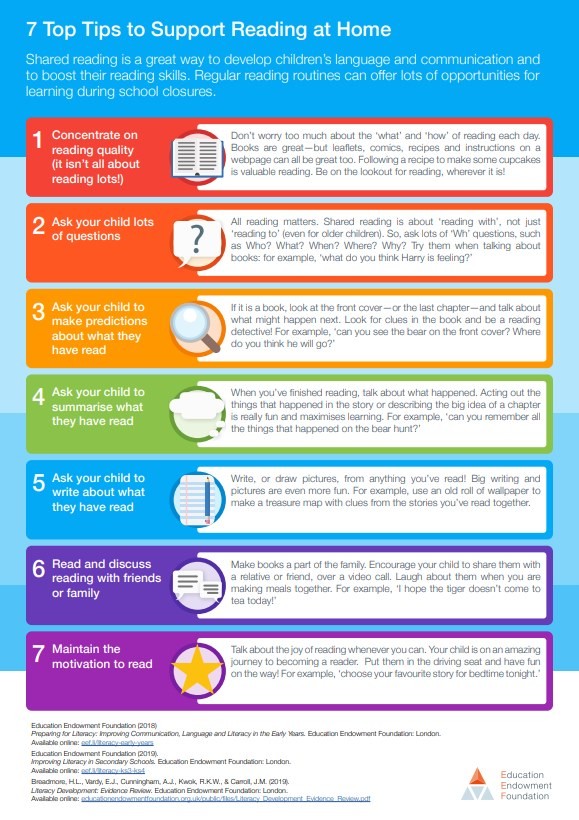
Below are some top tips from the Education Endowment Foundation about how to support your child with reading.
If you would like to know more about our English Curriculum, please visit this webpage: Curriculum
How is writing taught at The Discovery School?
At The Discovery School, we aim to develop confident, capable and enthusiastic writers who can communicate effectively for a range of purposes and audiences. We recognise that writing is a complex process and provide a carefully sequenced curriculum that builds children's knowledge, skills and independence from the Early Years Foundation Stage (EYFS) to Year 6.
Our writing curriculum is built around high-quality texts that inspire children, develop their imagination and provide meaningful contexts for writing. We want children to see themselves as authors and understand that writing is a powerful way to communicate ideas, express themselves and engage with the world.
In EYFS, children develop the foundations of writing through mark-making, drawing, early letter formation and the development of fine motor skills. They are encouraged to give meaning to their marks, write for different purposes and apply their developing phonics knowledge to write words and simple sentences. Oracy, storytelling, role play and shared writing provide opportunities to develop vocabulary and confidence in expressing ideas.
In Key Stage 1, children build on these foundations by developing their transcription skills, including handwriting, spelling and sentence construction. Through carefully planned writing units based on high-quality texts, children explore different genres and purposes for writing. Oral rehearsal, teacher modelling and shared writing help children to develop and organise their ideas before writing independently.
In Key Stage 2, children develop increasing control, accuracy and creativity in their writing. They learn to adapt their vocabulary, grammar, sentence structures and organisational choices for different audiences and purposes. Writing units provide opportunities to explore ambitious models of writing, develop technical accuracy and apply previously taught knowledge and skills. Children are encouraged to make deliberate authorial choices, edit and improve their work and develop their own distinctive writing style.
Across the school, our approach includes transcription (spelling and handwriting) and composition (articulation of ideas):
-
High-quality texts: Carefully chosen books provide inspiration, rich language and meaningful contexts for writing.
-
Oracy: Discussion, drama, storytelling and oral rehearsal help children to develop and articulate their ideas before committing them to paper.
-
Explicit teaching: Teachers model the writing process and explicitly teach vocabulary, spelling, punctuation, grammar and composition.
-
Handwriting: Handwriting and letter formation are taught progressively from EYFS through to Year 6, ensuring that children develop a fluent and legible script.
-
Spelling: In EYFS and KS1, spelling is taught daily through our systematic synthetic phonics programme called FFT. As children move into KS2, lessons transition to exploring spelling patterns, rules. morphology (word roots and prefixes/ suffixes) and etymology (word histories).
-
Progression: Our Writing Progression of Knowledge and Skills (POKAS) ensures that knowledge and skills are taught systematically and revisited to secure learning over time.
-
Vocabulary development: Children are explicitly taught new vocabulary and encouraged to use increasingly ambitious language in their writing.
-
Purpose and audience: Children write for a range of real and imagined purposes, developing an understanding of how writing changes depending on its intended audience.
-
Adaptive teaching: Teachers use ongoing assessment to identify children's starting points, address misconceptions and provide appropriate scaffolding and challenge.
-
Editing and improving: Children are taught to evaluate, refine and improve their writing, developing independence and pride in their work.
Our ambition is for every child to leave The Discovery School as a confident and independent writer, equipped with the knowledge, skills and creativity to communicate effectively across a range of contexts.
For more information about our English Curriculum, please click here: Curriculum