
Pupil Premium
Statement of Intent
All members of staff and the governing board accept responsibility for disadvantaged pupils and are committed to meeting their pastoral, social and academic needs within a caring and nurturing environment. Our intention is that all pupils, irrespective of their background or the challenges they face, make good progress and achieve high attainment across all subject areas. The focus of our pupil premium strategy is to support disadvantaged pupils to achieve these goals, including progress for those who are already high attainers.
We will consider the challenges faced by all disadvantaged pupils, including those who have special educational needs, have a social worker, are young carers or who are socially disadvantaged. The support we have outlined in this statement is also intended to support all children, regardless of whether they are disadvantaged or not.
We expect that each child will develop a love for learning and acquire skills and abilities commensurate with fulfilling their potential, now and in the future.
In line with the Strategic School Improvement Plan, a significant proportion of the funding will be spent on supporting children with accessing the core knowledge and skills needed to succeed in English and Mathematics. Without the skills, knowledge and expertise needed in these core areas, there will be a barrier to accessing the full curriculum. High-quality, adaptive practice in teaching is at the heart of our approach, with a focus on areas in which disadvantaged pupils require the most support. Children’s key stages of development are also a focus at The Discovery School.
Our strategy will follow a continuous, cyclical four-step approach:
- Diagnosis of our children’s challenges and needs
- Strong research evidence which underpins our chosen strategy for support
- Implementation of our chosen strategy
- Monitoring and evaluation
This is proven to have the greatest impact on closing the disadvantage attainment gap and at the same time will benefit the non-disadvantaged pupils in our school. Implicit in the intended outcomes detailed below, is the intention that non-disadvantaged pupils’ attainment will be sustained and improved alongside progress for their disadvantaged peers.
Early identification of any barriers to learning for children, but particularly for those that experience disadvantage, is paramount. Identification includes holistic barriers, such as social, emotional, and mental health challenges, as well as the social exclusion that can be experienced when living in an affluent area. The Inclusion Team and the Social, Emotional and Mental Health Team will support staff in identifying how children can be best supported and will plan accordingly.
Our approach will be inclusive and responsive to common challenges and individual needs, rooted in robust diagnostic assessment, quality first teaching and underpinned by best practice and recognised research.
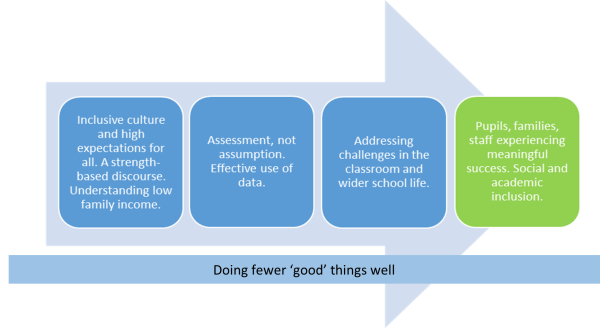
To ensure our strategy is effective, we will:
- Ensure we have an inclusive culture, which advocates a strength-based discourse
- Foster a culture of high expectations, which ensures disadvantaged pupils are challenged in the work that they are set
- Adopt a whole school approach in which all staff take responsibility for disadvantaged pupils’ outcomes and raise expectations of what can be achieved
- Implement robust assessment systems – assess, not assume
- Act early to intervene at the point need is identified, both in the classroom and in wider school life
- Enable a community of social and academic inclusion
- Seek to do fewer things, but to a high standard, and with maximum impact
Pupil Premium and Recovery Premium Funding 2025/26
Please click on the document below for our report on this year's Pupil Premium and Recovery Premium funding.